
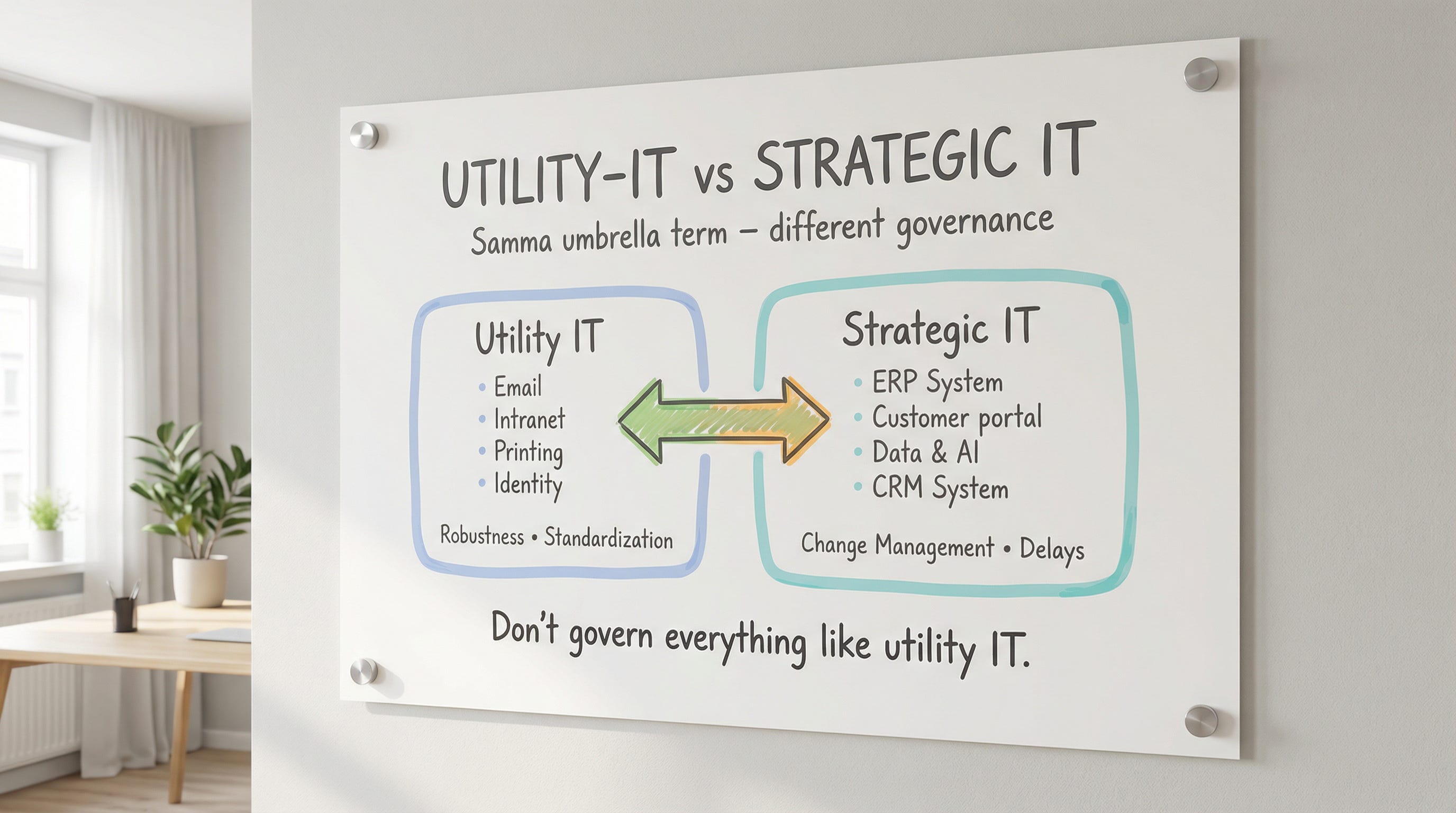
“IT” and “AI” have become umbrella terms.
Under the same label you’ll find everything from email and printing to systems that, in practice, decide how the business actually works. And now “AI” is becoming just as broad an umbrella: everything from a helpful chatbot to extensive agentic workflows.
When things this different get lumped into the same concept, it’s easy to start managing everything the same way: the same governance, the same budget logic, the same procurement approach, and the same expectation of predictability. And then people are surprised when some initiatives feel “easy” while others turn into multi-year learning journeys.
This isn’t a new insight. As far back as 2010, Martin Fowler—author and “Chief Scientist” at Thoughtworks—wrote about a split he calls the Utility vs Strategic Dichotomy.
Fowler’s point is that there are two very different types of IT. You can absolutely imagine more categories (and in practice there’s often a gray zone), but as a starting point his two groups are unexpectedly useful - especially when discussions otherwise get stuck on words like “agile,” “operations,” or “innovation.”
Utility IT: standardized services that just need to work
Utility IT is the keep-the-lights-on set of services you need every day: email, intranet, identity/login, printing, meeting tools, client platforms, and networks.
When they work, you barely notice. When they don’t, you notice immediately (and it can become very critical).
Utility IT can be compared to the hotel business. You can have different preferences (location, standard, price, framework agreement), but the basic needs are pretty similar. It should simply work as promised.
In Fowler’s language this is “utility”—things most people need and that should just work. He tells an anecdote about someone who said:
“Software is like sewage pipes. I want it to work reliably and I don’t want to know about the details.”
There’s also Utility AI. Just like Utility IT, it consists of standardized everyday services that can be hugely helpful and time-saving—such as generative AI assistants (like ChatGPT and Copilot). At the same time, you hardly need to care how they work—as long as they meet security requirements and legal requirements (especially around personal data).
This is also where many IT organizations are at their strongest. Utility IT (and Utility AI) rewards standardization, process discipline, and strict decision flows. It’s exactly the kind of work best suited for operational excellence: doing the same thing consistently, safely, and efficiently—and doing it a little better every day.
Strategic IT (and AI): what differentiates you
Which brand is on your computer is rarely decisive. Neither is which hotel you choose to stay at.
But if you’re going to buy a new house, that’s a completely different matter. There are many crucial questions: the neighborhood, whether you should buy or perhaps build a new house. Your choices will have a major impact on your life going forward—monthly costs, commute times, and not least how much you enjoy living there.
Strategic IT (and strategic AI) is the kind of thing that matters a lot—things that differentiate how the business is run.
It can be an ERP system, production planning, decision support, order-to-delivery, a customer portal, a pricing engine, or a booking flow that forces staffing and planning to work in a new way. Your choices matter enormously—just like the choices involved in buying or building a house.
Strategic IT (and AI) is where things most often go wrong.
Why? Because strategic IT (and AI) is rarely “just technology.” It’s change: ways of working, roles, responsibilities, trade-offs—and a lot of things that only become clear when systems meet reality. It requires learning, trade-offs, and often quite a bit of renegotiation of “how we do things around here.” And it’s often exactly the non-technical work that gets underestimated—usually the biggest part of all.
Strategic IT requires a holistic approach in a completely different way than Utility IT. That’s why it also requires leadership engagement. It also requires a different kind of responsiveness and prioritization than Utility IT. The very things that are strengths in Utility IT (standardization, process discipline, etc.) can reduce room for maneuver in Strategic IT—precisely where flexibility, re-evaluation, and speed are needed the most.
AI, data, and advanced analytics: often more strategic than you first think
While the vast majority of what falls under “IT” is Utility IT (according to Martin Fowler perhaps around 95%), AI is a different story.
Sure, there are often low-hanging “AI fruits.” Generative AI assistants can deliver quick productivity gains in everyday work and in many cases function as Utility AI. But the real value of AI, data, and advanced analytics usually only appears when ways of working, decisions, and behaviors change.
On top of that, the questions are often more complex than in traditional IT. The legal aspects are harder, accountability is less obvious, and the effects are more indirect. Decisions must be made under uncertainty, and risks must be weighed against alternative risks—that is, what happens if you don’t act. Without clear leadership engagement, initiatives risk getting stuck as paper products, pilot projects, or isolated experiments that never reach scale.
That’s why the split in AI is rarely 95/5 between utility AI and strategic AI. A significantly larger share of AI work has a strategic character.
Risks: different kinds of risk (and therefore different governance)
Utility IT risks are often about robustness: availability, recovery, security hygiene, and vendor risks. They’re often possible to define, measure, and follow up in a fairly straightforward way. There are established concepts and metrics: uptime, incident frequency, recovery time, patch levels, compliance, SLA fulfillment.
The risks are rarely trivial, but they are largely operational. They’re about something stopping working, working more slowly than it should, or being attacked. They’re risks that can be reduced through redundancy, standardization, clear processes, and disciplined operations.
That’s exactly why utility IT is well suited to governance that emphasizes stability, predictability, and continuous improvement. That doesn’t mean the risks are small—but they are a different type of risk than in strategic IT.
The risks of Strategic IT (and AI) look different. Here it’s less about whether the system is up or down—and more about whether you actually succeed with the change. The risks are more business-related and long-term: the solution doesn’t fit the ways of working, it’s implemented but not used as intended, it changes incentives in unexpected ways, or the effect doesn’t materialize even though the project is delivered according to plan.
There can also be major delays, scope creep, drawn-out programs that never quite finish, or an “eternal ramp-up” where the benefits are always just around the corner. The consequences are often more indirect and harder to measure: lost efficiency, reduced trust, strategic opportunities that slip away.
That’s exactly why strategic IT requires a different kind of governance. Here, service levels and operational metrics aren’t enough. You need active business engagement, the ability to adjust course along the way, and the ability to weigh risk against alternative risk—what happens if you don’t change.
Bimodal IT
So how do Utility IT and Strategic IT relate to the concept of “Bimodal IT”?
Gartner popularized the concept of bimodal IT, which is about handling two parallel modes of working: one optimized for predictability and one optimized for exploration. In other contexts this is also called “two-speed IT.”
The bimodal idea received a lot of criticism. Forbes, for example, called it “Gartner’s Recipe for Disaster,” partly due to the risk of creating the wrong incentives, organizational lock-ins, and an artificial split between “fast” and “slow” teams. Martin Fowler, in turn, has been clear that bimodal IT is not the same thing as his split between utility and strategic.
That difference matters. Utility IT versus Strategic IT is not about “fast vs stable.” It’s not a choice between speed and control. It’s a perspective on the nature of the work, the types of risks involved, and the governance needs—on what IT actually is to the business, and therefore how it should be led.
Another misunderstanding that bimodal thinking can reinforce is that speed and quality are opposites—that you have to choose between being fast or delivering high quality. For example, DORA’s research in software development suggests the opposite. Organizations that deliver quickly also tend to deliver with high quality. Speed and quality often correlate in high-performing teams. So it’s not that quality is achieved by slowing down—on the contrary, research indicates that well-functioning teams often manage both at the same time.
It starts by asking the right question
We need fewer questions about whether something is “IT” or “AI” - and more questions about what kind of task we’re actually facing.
Utility IT/AI keeps the lights on.
Strategic IT/AI determines where we’re going.
We need both. But they are not the same thing. And they don’t operate under the same logic.
Note! The content on this blog reflects my personal opinions and does not represent my employer. As the publisher, I am not responsible for the comments section. Each commenter is responsible for their own posts.